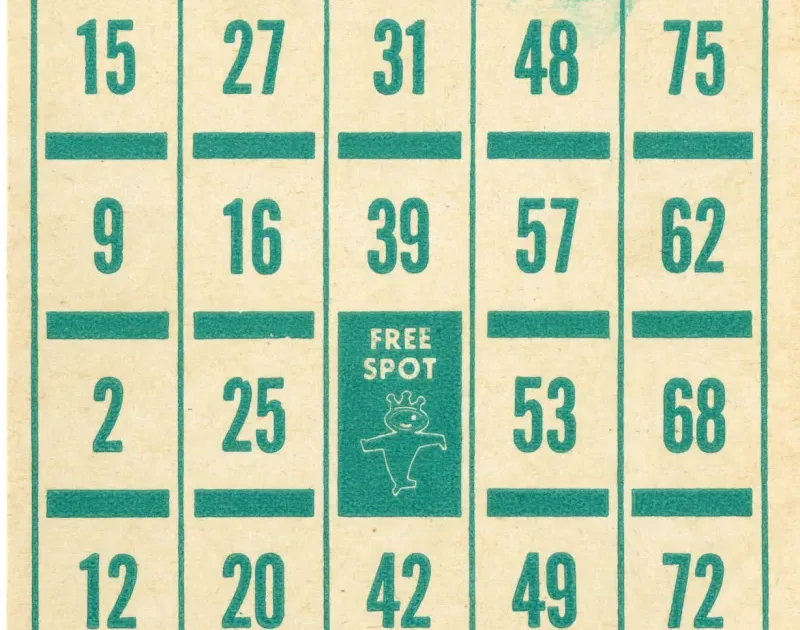
Bingo patterns are the specific arrangements of marked squares that a player needs to complete in order to win a game. While the classic straight line is the most common pattern, dozens of variations exist that add excitement and variety to bingo nights. This reference guide covers every standard pattern so you know exactly what to look for when the caller announces the game.
What Is a Bingo Pattern?
A bingo pattern is a predetermined shape or arrangement on the bingo card that players must complete by marking called numbers. Before each game begins, the caller announces which pattern is in play. Players then try to be the first to mark all the squares that make up that pattern. The pattern determines both the difficulty and duration of each game — simple patterns like a single line produce quick winners, while complex patterns like a blackout can take much longer.
Standard Line Patterns
Horizontal Line
Complete any full row across the card (five squares in a row). There are five possible horizontal lines on every card. This is one of the most common and quickest patterns.
Vertical Line
Complete any full column from top to bottom. There are five possible vertical lines, corresponding to the B, I, N, G, and O columns. The N column is easiest since it includes the free space.
Diagonal Line
Complete a line from one corner of the card to the opposite corner. There are two possible diagonal lines. Both pass through the free center space, giving you a head start.
Any line: When the caller says “any line” or “regular bingo,” it means any horizontal, vertical, or diagonal line counts. This gives players 12 possible winning combinations on a single card.
Four Corners Pattern
Mark only the four corner squares of the card: top-left, top-right, bottom-left, and bottom-right. This pattern requires exactly four specific numbers (since no corner is a free space) and typically produces a winner quickly. Four corners is commonly used as an opening warm-up game or as a bonus round between regular games. Because so few squares are needed, it is one of the fastest patterns to complete.
Postage Stamp Pattern
Complete a 2×2 block of four squares in any corner of the card. Unlike four corners (which uses one square from each corner), postage stamp uses four adjacent squares clustered together like a stamp on an envelope. There are four possible postage stamp positions — one in each corner of the card.
Double Postage Stamp Pattern
Complete two 2×2 blocks in opposite corners of the card simultaneously. This is significantly harder than a single postage stamp because you need eight specific numbers in exact positions. Double postage stamp games tend to run longer and are often paired with larger prizes.
Blackout / Coverall
Cover every single number on the entire card — all 24 numbered squares plus the free space. This is the longest, most challenging pattern and is typically reserved for the final game of the night with the biggest prize. A blackout game can require 50 to 60 or more numbers to be called before someone wins. Some halls set a number limit (for example, blackout in 50 numbers or fewer) for jackpot games.
Blackout strategy: Playing more cards dramatically improves your odds in blackout games. If you can handle four to six cards simultaneously, your chances of winning increase proportionally.
Letter Patterns
X Pattern
Mark both diagonals to form an X shape across the card. This requires 9 squares (both diagonals share the center free space), making it a moderate-difficulty pattern.
T Pattern
Mark the entire top row plus the entire center column. The T can also be played inverted (bottom row plus center column), rotated left, or rotated right.
L Pattern
Mark the entire left column and the entire bottom row to form an L shape. Can be rotated to any corner orientation.
Z Pattern
Mark the top row, bottom row, and the diagonal connecting them. Creates a Z shape across the card.
Other Popular Patterns
Diamond
Mark the squares that form a diamond shape in the center of the card, using the middle squares of each edge row and column.
Frame (Picture Frame)
Mark all squares around the outside border of the card, leaving the center 3×3 area empty. This requires 16 squares and is a longer game.
Cross (Plus Sign)
Mark the entire center column and the entire center row to form a plus sign. This requires 9 squares (the center free space is shared).
Custom Patterns for Themed Games
For special events and themed bingo nights, you can create custom patterns in virtually any shape: a heart for Valentine’s Day, a Christmas tree for holiday events, a star shape for awards ceremonies, or any design that matches your theme. Custom patterns add novelty and keep regular players engaged with fresh challenges. Draw the pattern on a board or display it on screen so all players can see what they are working toward.
How to Announce Patterns to Players
Always announce and display the required pattern before starting each game. Show it on a large board, projected screen, or printed handout. For complex patterns, walk through the pattern slowly and ask if anyone has questions before calling the first number. Clear communication prevents confusion and disputed wins.
For a complete beginner’s guide to bingo rules and gameplay, visit our how to play bingo page. Need cards for your game? See our bingo cards guide for printable and buyable options.
Keep exploring: Also explore bingo supplies and themed bingo games.
Frequently Asked Questions
Yes. The free center space counts as automatically marked for every pattern that passes through it, including lines, X patterns, crosses, and blackout. It gives every player a small head start.
Blackout (coverall) is the hardest pattern because you must mark every single square on the card. It requires the most called numbers and takes the longest to complete, which is why it is usually paired with the biggest prize.